About BoardStat
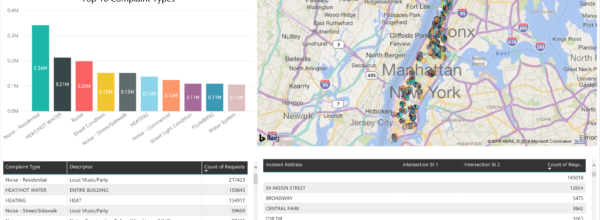
BoardStat shows what New Yorkers report to 311 in each community district and council district, and at a single address. You can see the most common problems, how long city agencies take to close requests, and where on the map they happen. We built it with community boards, for community boards, and anyone can use it.
What’s new in BoardStat 2.0
BoardStat 2.0 is a rebuild of the tool BetaNYC first made with the office of then-Manhattan Borough President Gale A. Brewer. The first version ran in Microsoft Power BI. Its data stopped refreshing in early 2025, and the dataset views it read from have since been removed. The new version does not need Power BI or any special servers.
- Community district and council district pages, with every request placed in today’s district lines from the Department of City Planning.
- Address lookups for addresses that appear in 311 requests since 2020, spelled the way the city records them. It is not a geocoder.
- Filters for dates, problem, description, agency, and status.
- How long agencies take to close requests.
- A web address that keeps your filters, a printable summary, and a CSV download of every matching request.
The data comes from NYC Open Data’s 311 Service Requests from 2020 to Present dataset, and BoardStat updates it every night. It covers requests from January 1, 2020, on. Requests from 2010 to 2019 are in a separate city dataset, and we plan to add them later.
BoardStat is open source. Read BoardStat’s code on GitHub.
A prototype we are building with the people who use it
BoardStat 2.0 is a prototype, and we are testing it with community boards. Tell us what helps, what is confusing, and what you wish it did: email boardstat@beta.nyc or see how to give feedback on BoardStat.
It is built on the city’s open data and is not an official City of New York tool.
What we measure
Every search and filter runs in your browser, and what you type into the search box is never sent anywhere. We count visits with Google Analytics, through the same Google tag the rest of beta.nyc uses. It tells us which pages and districts people look at, which filters they use (by name, not what was picked), roughly where a visit comes from, the device and browser, and, through cookies, whether you have been here before. When you look up an address, we remove it, and any map coordinates, before anything is sent to Google. Read what BoardStat measures about visits.
History
BoardStat began in the 2016–2017 school year, when BetaNYC’s Civic Innovation Fellows researched what community boards needed, then built the first version with BetaNYC staff, CUNY Service Corps, and help from Microsoft Civic. Staff from the Borough President’s office, district offices, and board members shaped it. It was created with funds and support from the Alfred P. Sloan Foundation, the Fund for the City of New York, and Microsoft Civic. In 2018 it expanded to all five boroughs, with tutorial videos, “data journey” worksheets, and public training sessions. Those classes, and the human-centered design work behind the first version, showed us how people actually use BoardStat, and that shaped how BoardStat 2.0 works. Read BoardStat’s full history, with links to the original discussions on GitHub.
At the 2017 launch
“We passed a first-in-the-nation Open Data Law and we’ve published more than 1,500 data sets with 750 million rows of data, but it’s not enough – the data doesn’t just need to be public, it needs to be usable,” said Gale A. Brewer, then Manhattan Borough President.
“Today, we operationalize the people’s data set for community boards,” said Noel Hidalgo, Executive Director of BetaNYC. “We used a human centered design process with the Manhattan Borough President and community boards to build a service request insight tool that meets their needs. Now, we launch a public beta of BoardStat to provide all New Yorkers with a simple dashboard to look at service request trends, location specific issues, and to evaluate how requests are assigned to agencies. In the coming months, we’ll be launching a series of public education classes to ensure all New Yorkers can read their own data.”