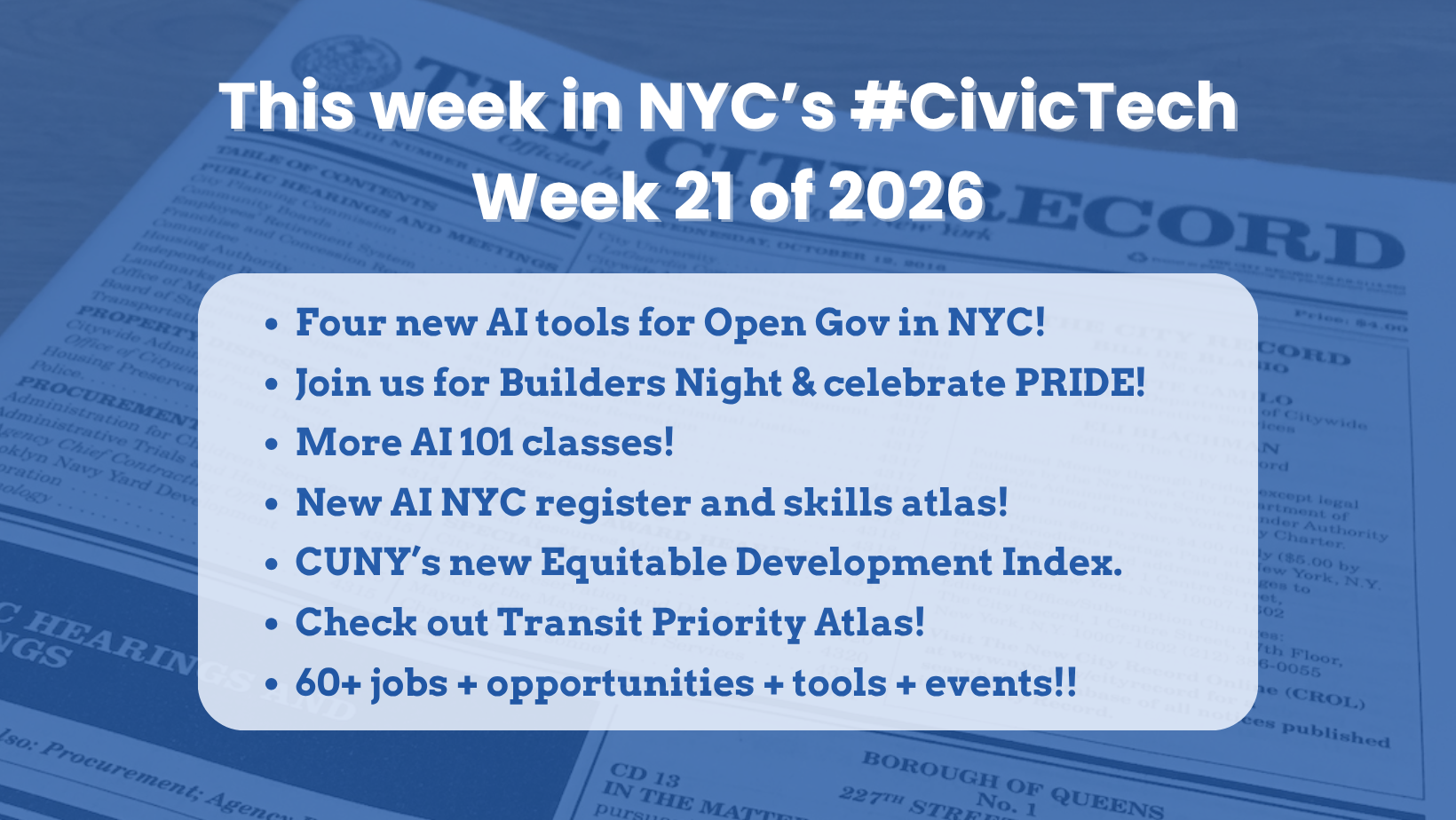
Today, we’re launching four new digital democracy tools for AI.
New York’s fight for public access to government information goes back to 1649 — when a Dutch lawyer named van der Donck went door to door in New Amsterdam collecting grievances, got thrown in jail for it, and still won. That fight never ended. It just accumulated laws: FOIL, the Open Data Law, Local Laws 37 and 38, and finally a Legistar API that took three years of civic pressure to pry open.
This week, we’re announcing the next step: BetaNYC is releasing four open-source tools that connect AI assistants directly to NYC’s civic data — the City Record, the Council’s legislative database, the City’s checkbook, and the full text of our Charter, laws, and rules. The argument is the same as 1649. The tools are different.
Read the full history and what we’re shipping.
Also: celebrate your civic tech pride and come build with us.
We’re hosting BetaNYC’s first Builders Night — and since June is Pride Month, we’re making it a Pride Night too. If you’re working on a cool queer project and want to show it off, we want to hear from you. Email events@beta.nyc to get on the agenda.
Details and RSVP → beta.nyc/event/e260623
— The BetaNYC team
Upcoming Events with BetaNYC
- Wednesday, June 10 Discovering NYC Open Data with NYC Open Data Ambassadors
Friday, June 12 Introduction to AI (AI 101) — Free community AI literacy session with the Manhattan Borough President’s Office and BetaNYC. (Currently at capacity)
Thursday, June 18 Introduction to Artificial Intelligence (AI 101) with Council District 17 & BetaNYC — Free virtual community AI literacy session with the Office of Council Member Justin Sanchez and BetaNYC
Tuesday, June 23 PIT Builders: Pride Tech Night
Civic Tech News & Updates
- This week at MakeShift 2026, DTPR launched an AI NYC register that makes Local Law 35 of 2022, NYC’s only AI accountability law, more accessible. This is exactly the type of interface we need to see to make AI transparency a reality.
- The Evens Foundation outlines a two-step strategy for protecting healthy digital democracy — worth a read for anyone thinking about platform governance and civic information resilience.
- NY FAIR News Act moves toward a floor vote — WGAE, SAG-AFTRA, DGA, and the NewsGuild rallied in Albany to pass S.8451, which would require AI disclosure in news content and mandate human editorial review before publication — a transparency rule backed by the Times, New Yorker, CBS, and ABC that backers say could set a national standard. — WGAE
- NYC Comptroller releases a practical blueprint for FOIL — Built on four years and 20,000+ records requests (100% response rate), “Sunlight in the City” gives every city agency concrete guidance: centralized portals, clear timelines, staff training — and notably, terminates the Confidential Protocol Agreement with NYPD, reopening surveillance contract disclosures. — NYC Comptroller
- Open-source tool helps states track Medicaid requirements under H.R. 1 — Nava PBC is building OSCER, a modular, open-source application for states to track community engagement requirements without locking into proprietary vendors — public demo days running now. — Nava PBC
- Under Mayor Mamdani, NYC’s delivery minimum wage law returned $4.6 million in back wages to workers whom UberEats, Fantuan, and Hungry Panda had underpaid or improperly deactivated — now a tech-industry group is calling that outcome a problem.
- City College of New York’s J. Max Bond Center received a Sloan Foundation grant to build the Equitable Development Index — a data tool designed to strengthen transparency and community voice in NYC’s housing and land-use review process.
AI Roundup
- Data & Society launches AI Civics to build public power over technology — A two-year, $2M initiative backed by Humanity AI, AI Civics will equip communities — starting with the Digital Public Library of America’s library network, then labor groups, faith organizations, and educators — to meaningfully participate in AI governance and oversight. Directly complements the local work underway through the NYC GUARD Act and a proposed federal counterpart. — Data & Society
- Abeba Birhane’s new entry in MIT’s Open Encyclopedia of Cognitive Science traces the history of algorithmic bias from 1950s computing through today’s generative AI, including the field’s ongoing debates and unresolved controversies.
- Jill Lepore in The New Yorker traces a century of schemes to automate authorship — from the Plot Robot to Auto-Beatnik — putting today’s AI content moment in long historical perspective.
- Code for America and Anthropic launch an AI tool for SNAP caseworkers — Announced at the CfA Summit, the Claude-powered tool gives caseworkers real-time access to SNAP policy across federal, state, and county levels — built to scale to other benefits programs. — PR Newswire
- Vox examines the real tradeoffs of hosting a data center: local tax revenue for municipalities, yes — but also significant new demands on energy grids and community water supplies.
- Minnesota Governor Walz signed HF1606, the first U.S. law explicitly prohibiting AI nudification and deepfake pornography services. It takes effect August 2026.
- The Gates Foundation and Anthropic announced a partnership to build AI tools in global health, education, and agriculture.
Community Wins, and Featured Tools
- CourtListener — the largest free database of U.S. court opinions — is now available as an MCP connector inside Claude, giving AI tools grounded access to primary legal sources and reducing hallucinated citations.
- Vital City “tries” to layer on crime and 311 complaints about lighting conditions. The caveats are important to note: how the NYPD moves the data point and how NYC 311 has a data reporting bias. See their map
- Four open-source AI tools for government caseworkers — tested in the real world — Nava Labs released a referral generator, policy chatbot, DocumentAI, and agentic form-filler built with and for government caseworkers; in an evaluation with 125 workers, decision accuracy improved ~40%. The tools target $227B in unclaimed annual benefits. — Nava PBC
- The AI Skills Atlas is a new tool from an AI sprint for nonprofits — helps teams map and understand AI capabilities relevant to their work.
- A new open data visualization tool maps NYC locations where pedestrian crash rates are disproportionately high relative to actual foot traffic — useful for safety advocates, planners, and researchers.
- Studio 2263’s Transit Priority Atlas maps strategies cities worldwide use to speed up street-running transit — a free resource for researchers, practitioners, and decision-makers.
- Code for America names a new CTO with state AI experience — Jonathan Porat, former California State CTO, joins from California’s Office of Digital Innovation — a signal that CfA is moving from AI pilots to system-level deployments. — Code for America
Jobs & Opportunities
- Kelly Jin, a former chief analytics officer for the City of New York, is launching a $25,000 Catalyst Fund this summer to provide five unrestricted $5,000 grants to nonprofits or projects building civic infrastructure and community connectedness. No lengthy application process — just a short 5-minute form.
- Program Operations & Data Systems Manager — AI for Nonprofits Sprint / Fund for the City of New York — Hybrid (NYC). $55,000–$70,000. Full-time through March 2027. Own the data infrastructure (Airtable, Zoom, Zoho, integrations) for a program that trained 38,000 nonprofit staff in year one and is scaling to 100,000. Strong fit for systems-minded ops people comfortable with automation and AI tools.
- Senior Operations Director — AI Now Institute
Applications due May 25. - Program Associate — AI Now Institute
Applications due May 25. - Communications Associate — AI Now Institute
Applications due May 25. - Instructional Designer & Facilitator — Tech:NYC Foundation
- Urban Designer — NYC (Manhattan)
- Chief Product Development Officer / Deputy Commissioner for Product Development — NYC (Brooklyn)
- Graphic Design Deputy — NYC (Manhattan)
- Graphic Design Intern — NYC (Manhattan)
- Bus Seating Planner, Furniture & Operations Unit — NYC (Manhattan)
- GIS Technology & Engineer Fellow (Fall) — MTA
- Tech for Good Project Fellow — Tech Matters
- Data & Policy Graduate Fellow, AI Policy & Public Projects — NJ Office of Innovation, New Brunswick / Remote
- Manager of Programs & Events — Historic Districts Council — NYC. $60,000–$65,000. Applications due June 5.
- Communications Coordinator — Historic Districts Council — NYC, part-time. $30/hr, 10–20 hrs/week. Applications due June 5.
- Visual Design Associate, Term-Limited — ACLU National Office, New York. 2-year term starting September 2026. $89,020.
- Head of Editorial + Platforms, Mozilla Ecosystem — Mozilla, Remote US. $139,000–$175,000.
- Senior Program Officer — Charles H. Revson Foundation — NYC. $180,000–$200,000. Urban Affairs & Education portfolio.
- Finance & Administration Manager — Pregnancy Justice — New York (Hybrid)
- Major Gifts Officer — Pregnancy Justice — New York (Hybrid)
- Staff Attorney — Pregnancy Justice — New York (Hybrid)
- Research Assistant — Pregnancy Justice — New York (Hybrid)
- Assistant Analyst, Education Team — NYC Independent Budget Office — NYC. $70,000–$77,000. Applications due June 1.
- Data Analyst — YMCA of Greater New York — NYC (Manhattan)
Events
- Sunday, May 24 at 3:30pm The 401st Birthday of New York City — Data Vandals Newsstand — Downtown 6 platform, 51st & Lexington. Speakers on subway history, city data, and NYC culture; music; costume contest (come dressed as your favorite New Yorker). Free.
- Tuesday, May 26 at 5pm The City as Commons: New Stories of Climate Justice — Anew + Global Rise + Climate Film Festival. 526 Hudson St. First of three workshops on climate justice storytelling in NYC, with speakers from WE ACT for Environmental Justice and the Waterfront Alliance. Free (suggested donation $30).
- Tuesday, May 26 at 6pm AAPI: Shaping Culture, Creativity & Entrepreneurship — Nuwa Marketing + Spring Place. Panel with AAPI leaders across art, wellness, tech, and venture-building. Registration required.
- June 1–7 NYC Tech Week 2026 — 1,000+ events citywide, including civic-tech sessions at Civic Hall, NYCEDC, and the NY Tech Alliance. Civic picks include Code for Climate (June 6) and Robin Hood Foundation Demo Day (June 3).
- Monday, June 1 at 6pm NY Tech Meetup: Software for Hardware — Robotics & Embodied AI — NY Tech Alliance + NY Robotics. Civic Hall. Live demos and talks from founders building at the intersection of software and hardware. $20.
- Monday, June 2 at 9am Great Civilization Hackathon — One-day civic-tech sprint at Newlab’s Dock 72 in Brooklyn; teams build public-interest tools in a day.
- Tuesday, June 2 at 3pm How do you have a conversation with a city? — Data Vandals Newsstand — Downtown 6 platform, 51st & Lexington. Official #NYTechWeek event: collect and analyze data collaboratively on the platform. $5 suggested.
- Friday, June 5 at 5pm Billion Oyster Project Pride Kickoff — Governors Island. Screening of How to Survive a Plague followed by a discussion on collective activism, climate, and creative survival.
- Monday, June 8 at 6pm TechCongress NYC Happy Hour — Frying Pan NYC, 207 12th Ave. Casual civic tech and tech policy happy hour hosted by TechCongress — the fellowship that places technologists in Congressional offices. Marks the start of recruitment for January 2027 Congressional Innovation Fellowships. RSVP required.
- Thursday, June 11 at 8:30am 2026 Nonprofit OpCon — City & State / NYN Media
- June 22–26 UN Open Source Week 2026 — United Nations Headquarters, New York
- June 23 at 6pm Pride: Grassroots Documentary Making with Q-Wave — Queens Library, Flushing (41-17 Main St). Learn documentary filmmaking from the Q-Wave collective — a queer AANHPI organization — and how to surface community stories. Free; registration encouraged.
- Now through summer Trees Count — NYC Street Tree Census — NYC Parks Department. Multiple events throughout the city; registration is open.
Media to Watch, Listen, or Read
- [READ] Six in ten New Yorkers cannot cover basic living costs and fall roughly $40,000 short annually, according to a new Urban Institute report covered by Gothamist.
- [READ] What the NY FAIR News Act would actually require — A clear breakdown of S.8451 — AI disclosure, human editorial review, and the coalition behind it — good background before the likely floor vote. — Nieman Lab
- [WATCH — coming soon] CfA Summit 2026 — The May 7–8 Chicago summit covered AI in government and benefits delivery modernization; mainstage recordings are expected on YouTube in coming weeks. — Code for America
- [READ] The highway lobby employs hundreds of lobbyists and spends over $100 million a year — through direct lobbying, campaign contributions, and public pressure — to protect a car-dependent transportation system, according to a new Union of Concerned Scientists breakdown.
- [READ] GitHub’s Eric Bailey writes up what the team learned building a general-purpose accessibility agent: AI works best channeled into narrow, high-confidence tasks — broad deployment tends to create as many problems as it solves.
- [READ] New research on Argentina’s Dirty War finds that ordinary career pressures — the desire for a promotion or a stalled career revived — were enough to push mid-level officials to violate professional norms and basic morality. A data point worth sitting with.
- [READ] Code for America’s second annual Government AI Landscape Assessment is out — Most states are still piloting; measuring outcomes is nascent. CfA helped 7M people access $22B in benefits in 2025. Leading states: MD, NJ, NC, PA, TX, UT, VT. — PR Newswire
BetaNYC is a civic organization improving lives through civic technology, design, and open data. Join our Slack · Subscribe to the newsletter · Support our work · Follow us on Bluesky, LinkedIn, Facebook, Instagram, Threads, Mastodon, Reddit, and YouTube.
